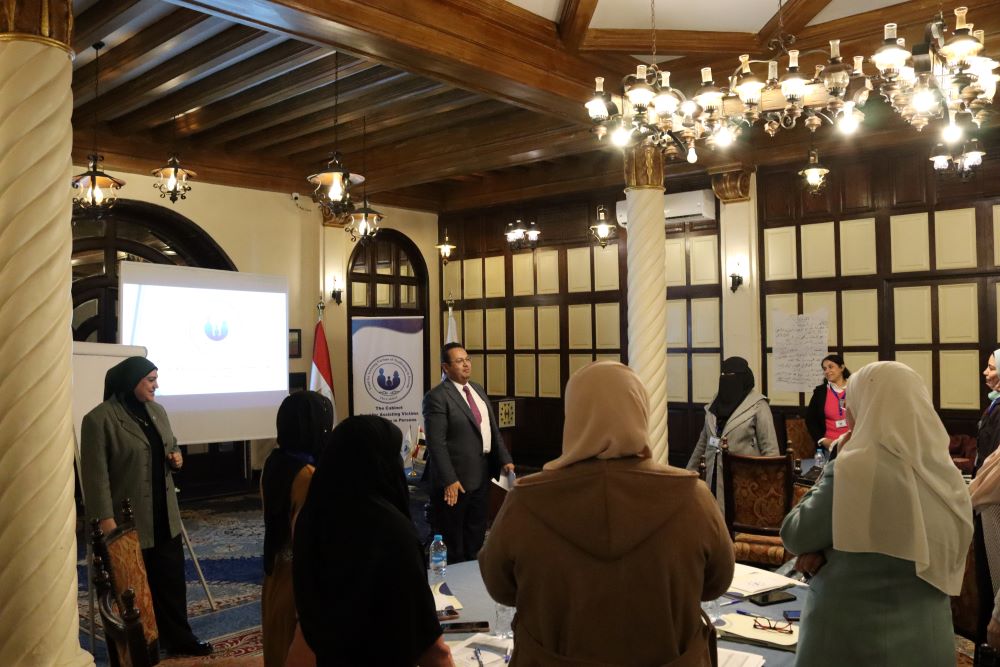
The Fund for Assisting Victims of Human Trafficking organized an intensive training course in Fayoum Governorate from 9 to 11 December, in cooperation with the National Coordinating Committee for Combating and Preventing Illegal Migration and Human Trafficking and the Ministry of Social Solidarity, to train and raise awareness among social pioneer women regarding human trafficking crimes.This course marks the launch of the Fund’s training activities across the governorates of the Republic, with the aim of building a national network of trained community cadres capable of identifying and combating human trafficking crimes. The course targeted 30 social pioneer women representing all centers and cities of the governorate, enabling them to serve as a first line of defense within their local communities.
Ambassador Dina El-Sayeh, Executive Director of the Fund, and Dr. Rasha Fahmy, representative of the Ministry of Social Solidarity, delivered remarks on the forms of human trafficking, the importance of training social pioneer women, and their effective role in raising awareness among families across the governorates. At the conclusion of the course, Ambassador Naela Gabr, Chairperson of the National Coordinating Committee for Combating and Preventing Illegal Migration and Human Trafficking, delivered a speech on the dangers of human trafficking crimes, emphasizing that wherever there is exploitation of an individual, this constitutes a form of human trafficking.
The sessions included an introduction to the role of the National Committee and the various forms and manifestations of human trafficking, such as [transactional marriage, exploitation of homeless children, forced labor, domestic work, sexual exploitation, and organ trafficking], in addition to the role and mandates of the Fund and the types of assistance it provides to victims, alongside interactive presentations and real-life case studies.
The sessions also discussed the social and economic factors contributing to human trafficking crimes and provided a simplified explanation of the Egyptian legal framework governing the combating of such crimes, represented by Anti-Human Trafficking Law No. 64 of 2010. They also addressed victims’ rights, witness protection, and included sessions on developing the communication and guidance skills of social pioneer women to enable effective engagement with families and communities.
On another note, a number of the social pioneer women praised the content of the training courses and the valuable information they provided, which equipped them with simplified knowledge about the role of the Fund for Assisting Victims of Human Trafficking and the support it offers to victims, as well as the forms of human trafficking and methods of identifying such crimes, in addition to understanding how to protect against all forms of exploitation. Others also commended the communication skills training they received and how to raise awareness among those around them about the dangers of these grave crimes and the importance of reporting through the hotlines.
On the sidelines of the course activities, Ambassador Dina El-Sayeh, Executive Director of the Fund, conducted several meetings and field visits with local leaders in Fayoum Governorate to discuss ways of addressing some of the governorate’s needs within the Fund’s area of competence. She met with the First Undersecretary of the Ministry of Social Solidarity and Director of the Social Solidarity Directorate in the governorate, as well as the Director of the Endowments Directorate, the Deputy of the Coptic Orthodox Diocese, the Rapporteur of the National Council for Women, the Head of the Child Protection Committee, and the Director of the Micro, Small, and Medium Enterprise Development Agency.
It is worth noting that the Fund for Assisting Victims of Human Trafficking was established pursuant to Presidential Decree No. 349 of 2024 and was officially launched last November. The Fund provides comprehensive support to victims in cooperation and coordination with the relevant ministries and entities.
تواصل -معنا